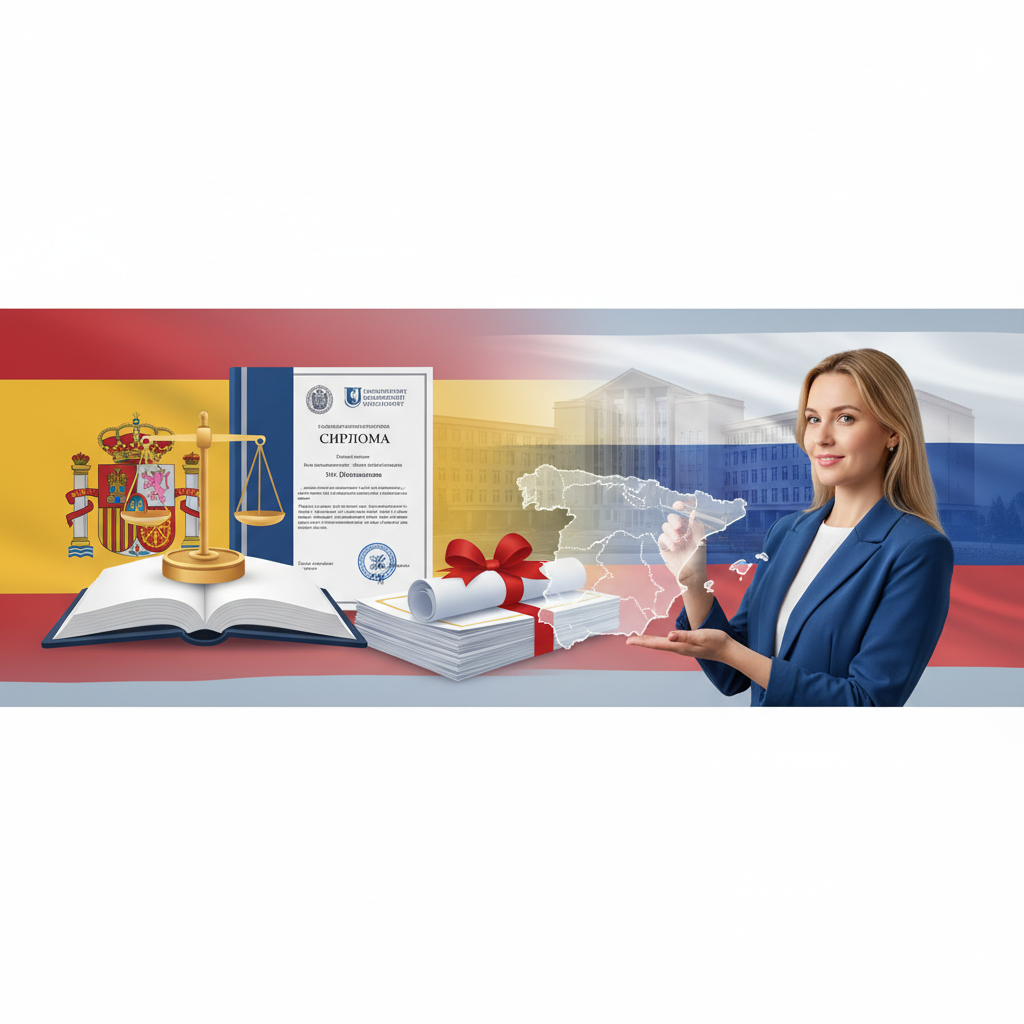
Understanding the Process of Homologation of a Diploma in Spain: A Strategic Legal Perspective
- Home
- Useful information
- Post
For many international professionals, particularly those arriving from Russia and other non-European Union countries, Spain offers a wealth of professional opportunities. However, transitioning a career across borders involves more than just physical relocation; it requires the legal recognition of academic qualifications. This process, known as the Homologation of a diploma in Spain (or Омологация диплома в Испании), is a critical step for anyone wishing to practice a regulated profession within the Spanish territory.
The complexity of Spanish administrative law can be daunting. Navigating the bureaucratic requirements of the Ministry of Universities requires precision, patience, and a deep understanding of current regulations. For the clients of Vera Grigoryeva, a seasoned legal expert specializing in assisting the Russian-speaking community in Spain, understanding the nuances of this process is the first step toward professional integration and success.
It is essential to distinguish between the various types of degree recognition available in Spain. The term Homologation of a diploma in Spain specifically refers to the official recognition of a foreign higher education degree as equivalent to a specific Spanish degree that grants access to a regulated profession. This is distinct from "Equivalence," which recognizes a degree's academic level (e.g., Bachelor’s or Master’s) but does not specifically authorize the practice of a regulated profession.
Regulated professions in Spain include, but are not limited to, doctors, lawyers, engineers, architects, and teachers. If your profession falls into this category, obtaining the Омологация диплома в Испании is not optional—it is a mandatory legal requirement. Without this certification, your foreign degree, regardless of the prestige of the issuing university, will not be legally recognized for professional practice in these specific fields.
The landscape of degree recognition in Spain underwent a significant transformation with the implementation of Royal Decree 889/2022. This legislation was designed to modernize and accelerate the processing of applications, which historically suffered from significant backlogs. The decree aims to digitize the process and ensure that resolutions are reached within a maximum period of six months, although in practice, administrative delays can still occur.
Under this framework, the application for the Homologation of a diploma in Spain must be submitted electronically. This shift toward digital administration requires applicants to possess a digital certificate or a Cl@ve identification, which adds another layer of administrative preparation for those newly arrived in the country. Vera Grigoryeva’s legal team frequently assists clients in securing these digital credentials to ensure a smooth start to their application.
To successfully navigate the Омологация диплома в Испании, the documentation must be flawless. The Ministry of Universities is rigorous in its evaluation, and any discrepancy can lead to a formal request for corrections (requerimiento), which significantly delays the process. The standard requirements include:
1. Proof of Identity: A valid passport or NIE (Foreigner Identity Number).
2. The Degree/Diploma: An official copy of the degree certificate, which must be legalized via the Hague Apostille if the issuing country is a signatory to the convention (which includes Russia).
3. Academic Transcripts: Detailed records of the subjects studied, hours completed, and credits earned.
4. Language Proficiency: For many professions, applicants must demonstrate a B2 level of Spanish (DELE or SIELE), particularly if the degree was not obtained in a Spanish-speaking country.
5. Proof of Payment: The payment of the administrative fee (Tasa 079).
It is important to note that all documents in Russian must be accompanied by a "Traducción Jurada" (sworn translation) performed by a translator authorized by the Spanish Ministry of Foreign Affairs. Simple translations are not legally valid for this process.
While an individual can technically apply for the Homologation of a diploma in Spain on their own, the high rate of administrative rejection or suspension makes professional legal counsel highly advisable. Vera Grigoryeva provides a specialized bridge for Russian citizens, ensuring that the nuances of the Russian educational system are correctly interpreted and presented to the Spanish authorities.
A legal expert can provide a preliminary assessment of the degree's compatibility with Spanish standards, identify potential gaps in the curriculum that might require additional exams (requisitos formativos complementarios), and manage all communications with the Ministry. This proactive approach minimizes the risk of the "administrative silence" that many applicants fear.
If your profession is not regulated—such as roles in business administration, marketing, or certain IT sectors—the Homologation of a diploma in Spain might not be necessary. In these cases, an "Equivalence to academic level" is often sufficient. However, for those seeking the Омологация диплома в Испании in highly technical fields like Medicine or Civil Engineering, the scrutiny is intense. The Ministry compares the competencies acquired in the foreign university with those required by the Spanish "BOE" (Official State Gazette) for that specific profession.
You can find the updated list of regulated professions and the specific requirements for each on the official Spanish Ministry of Universities website. Consulting this resource is vital for understanding whether your specific degree qualifies for homologation or if it must follow the equivalence route.
Managing expectations is a key part of the legal service Vera Grigoryeva offers. Although the current law stipulates a six-month window for a resolution, the reality of the Spanish administrative system often sees timelines extending between 9 to 18 months, depending on the volume of applications and the complexity of the specific case. During this time, it is crucial to maintain an active legal status in Spain and, if possible, engage in professional activities that do not require the full homologation while the process is pending.
The Homologation of a diploma in Spain (Омологация диплома в Испании) is more than just a piece of paper; it is the legal key that unlocks a professional's ability to contribute their expertise to the Spanish economy and society. Given the high stakes and the procedural rigors, relying on the expertise of a specialized lawyer like Vera Grigoryeva ensures that your professional transition is handled with the highest level of competence and care.
If you are a Russian professional planning your future in Spain, do not leave your credentials to chance. Proper legal preparation is the most effective way to ensure that your hard-earned qualifications receive the recognition they deserve in your new home.