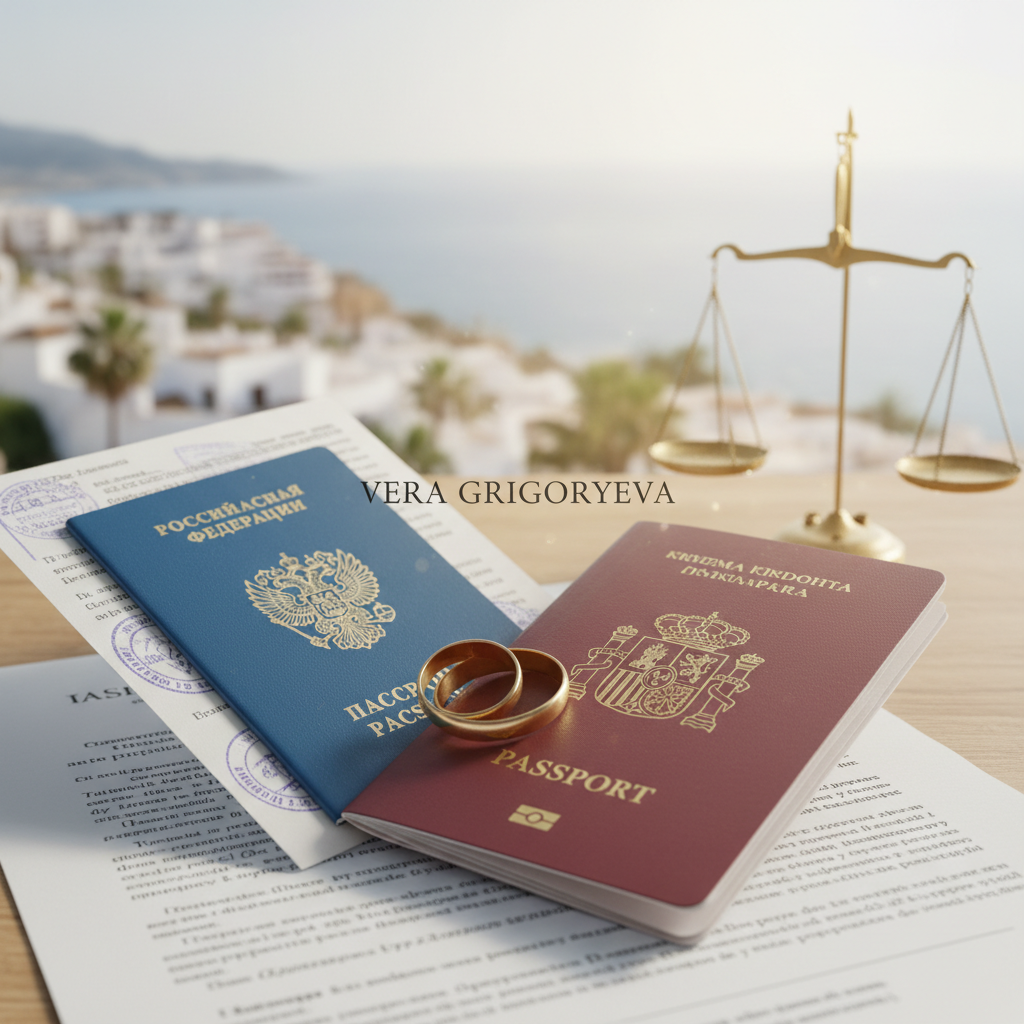
Legalization Through Marriage in Spain: A Comprehensive Guide for Russian Citizens
- Home
- Useful information
- Post
For many Russian citizens, Spain is not just a holiday destination but a place to build a future. However, moving to the Iberian Peninsula involves navigating a complex web of administrative and legal requirements. One of the most common and effective pathways for obtaining legal status in the country is through a union with a Spanish citizen or a citizen of another European Union (EU) member state. This process, often referred to as legalization through marriage, provides a stable legal framework for foreign nationals to live, work, and integrate into Spanish society.
While the prospect of obtaining residency through family ties is attractive, the legal procedures are rigorous and require meticulous attention to detail. Vera Grigoryeva, a seasoned legal expert specializing in Spanish immigration law for the Russian-speaking community, emphasizes that success in these cases depends largely on the correct preparation of documents and a deep understanding of the current legislative environment. This article provides an overview of the legal mechanisms, requirements, and common pitfalls associated with legalization through marriage in Spain.
When a Russian citizen enters into a legal union with a Spaniard or an EU national residing in Spain, they become eligible for the "Tarjeta de Residencia de Familiar de Ciudadano de la Unión" (Residency Card for Family Members of a Union Citizen). This permit grants the holder the right to live and work in Spain under the same conditions as Spanish citizens for an initial period of five years.
It is important to note that legalization through marriage in Spain encompasses two primary forms of legal unions: civil marriage (matrimonio) and registered de facto partnerships (pareja de hecho). Both paths lead to the same residency rights, but the administrative requirements and regional regulations may vary significantly. For instance, the registration of a "pareja de hecho" is governed by the autonomous communities, meaning the rules in Catalonia might differ from those in Madrid or Andalusia.
To initiate the process of legalization through marriage, several fundamental criteria must be met. The Spanish authorities are particularly vigilant about "marriages of convenience," which are unions entered into solely for immigration benefits. Therefore, providing proof of a genuine relationship is paramount.
The primary requirements include:
The marriage or civil partnership must be officially registered in the corresponding Spanish registry. If the marriage took place in Russia or another country, it must be transcribed into the Spanish Civil Registry. This step is often where many applicants face delays, as the transcription process can be time-consuming.
The EU citizen must demonstrate sufficient financial resources to support the family unit. This can be proven through a contract of employment, proof of self-employment, or significant savings. The goal is to ensure that the family will not become a burden on the Spanish social assistance system.
Unless the EU citizen is working and contributing to the Spanish Social Security system, the Russian spouse must have private or public health insurance that provides full coverage in Spain, equivalent to that provided by the National Health System.
Detailed official guidelines regarding these requirements can be found on the Spanish Ministry of Inclusion, Social Security and Migration portal.
For Russian citizens, the documentation phase is perhaps the most critical. All documents issued by Russian authorities must be apostilled and translated into Spanish by an official sworn translator (traductor jurado) recognized by the Spanish Ministry of Foreign Affairs. Vera Grigoryeva’s legal practice often highlights that errors in translation or the absence of a proper apostille are the most frequent causes of application denials.
Commonly required documents from the Russian side include:
• A valid internal and international passport.
• Birth certificate.
• Certificate of marital status (proving that the applicant is single, divorced, or widowed).
• Criminal record certificate (if required for specific types of residence or subsequent citizenship applications).
On the Spanish side, the EU citizen must provide their DNI or NIE (green card), the certificate of registration in the local municipality (empadronamiento), and the official marriage or partnership certificate.
A significant hurdle in the process of legalization through marriage is the "Audiencia Reservada" or the preventive interview. To curb fraudulent unions, the Civil Registry or the Immigration Office (Extranjería) may conduct separate interviews with both partners. They will ask detailed questions about their personal lives, family backgrounds, and daily routines to verify the authenticity of the relationship.
Failure to answer consistently can lead to a denial of the marriage registration or the residency permit. Professional legal counsel is highly recommended during this stage to help couples understand the nature of the interview and ensure that their documentation accurately reflects their shared life.
One of the most significant advantages of legalization through marriage is the shortened timeline for acquiring Spanish citizenship. Under standard procedures, Russian citizens must reside legally in Spain for ten years before applying for naturalization. However, if a foreign national is legally married to a Spanish citizen, they can apply for citizenship after only one year of legal residency in the country.
This "fast-track" citizenship is a major incentive, but it requires that the marriage remains valid and that the couple lives together for the entire duration of the application process. It is important to distinguish that this benefit applies to marriage (matrimonio) and not necessarily to "pareja de hecho" in the same way across all legal interpretations.
Given the bureaucratic hurdles and the high stakes involved, many Russian citizens seek the assistance of specialized lawyers like Vera Grigoryeva. A lawyer’s role extends beyond merely filling out forms; it involves strategic planning, identifying the most suitable autonomous community for registration, and representing the client before the Spanish authorities.
Legalization through marriage is not just an administrative procedure; it is the foundation of a new life in Europe. Expert guidance ensures that the process is handled with the professionalism and discretion it requires, minimizing risks and maximizing the chances of a favorable outcome. For those coming from Russia, having a legal representative who understands both the Russian documentary reality and the Spanish legal system is an invaluable asset.
In conclusion, while the path of legalization through marriage offers a clear route to residency and eventual citizenship in Spain, it demands a high degree of preparation. By understanding the legal requirements and seeking professional advice, Russian citizens can successfully navigate the Spanish immigration system and focus on their integration and future in their new home.