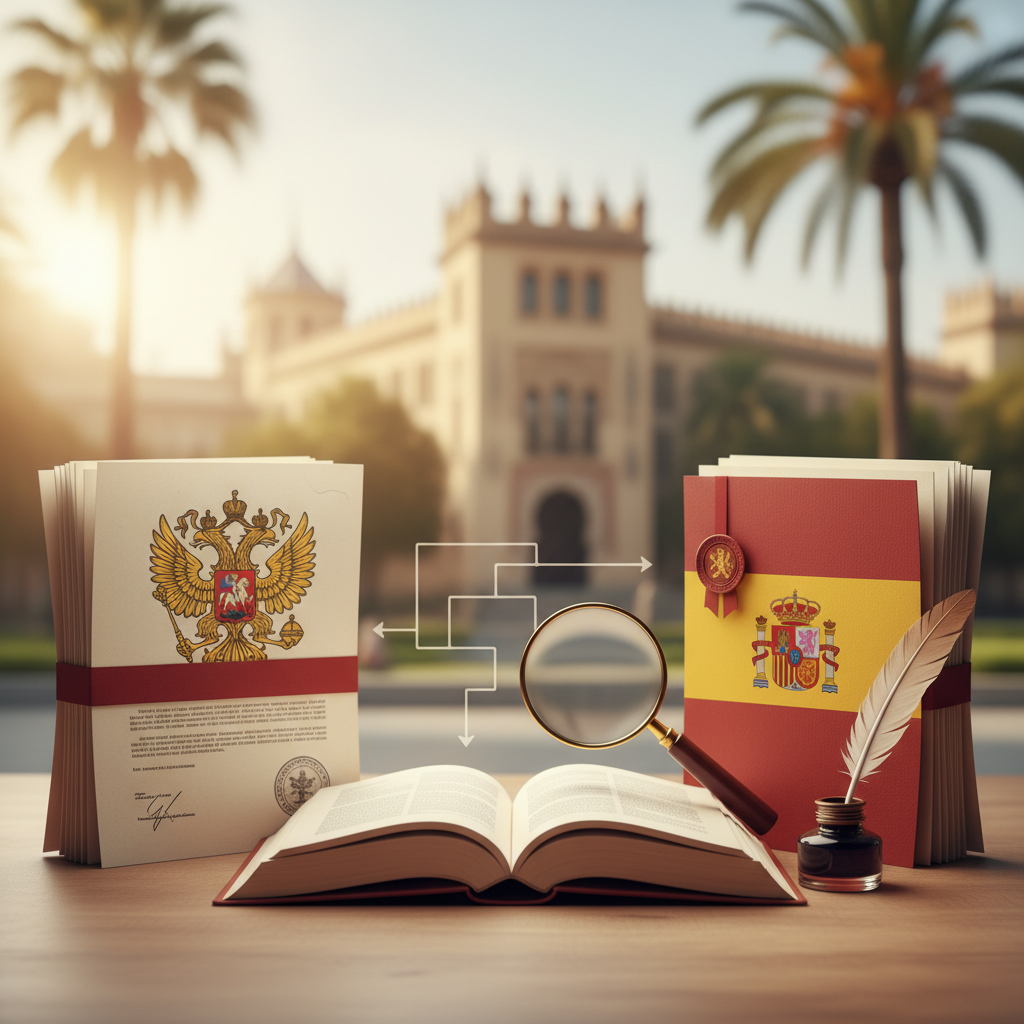
Legalization of Documents in Spain: A Comprehensive Guide for International Residents
- Home
- Useful information
- Post
Relocating to a new country involves a multitude of administrative tasks, many of which revolve around the recognition of foreign documentation. For Russian citizens moving to or living in Spain, the process of ensuring that certificates, diplomas, and legal papers are recognized by local authorities is a critical step. This process, known as the legalization of documents in Spain, is essential for everything from obtaining a residency permit to enrolling children in school or purchasing property. Understanding the nuances of international law and Spanish administrative requirements is vital to avoid delays and legal complications.
Legalization is the administrative act through which a foreign public document is validated, verifying the authenticity of the signature, the capacity in which the signatory of the document has acted, and, where appropriate, the identity of the seal or stamp which the document bears. When a document issued in Russia is to be used in Spain, it must undergo a specific procedure to be considered legally valid by Spanish institutions such as the Oficina de Extranjería or the Civil Registry.
Fortunately, both Russia and Spain are signatories to the Hague Convention of October 5, 1961. This international treaty simplified the legalization process by introducing the "Apostille." An Apostille is a certificate attached to the original document that confirms its authenticity and allows it to be recognized in all other member countries without the need for further consular legalization. Consequently, for most Russian documents, the legalization of documents in Spain begins with obtaining this stamp in the country of origin.
Not every piece of paper needs to be legalized, but official documents issued by government bodies almost always do. The most common categories include:
It is important to note that documents usually must be legalized in their original form. Furthermore, many Spanish authorities require these documents to have been issued within the last three to six months to ensure the information is current, especially regarding civil status and criminal records.
While the Apostille verifies the authenticity of the document, it does not solve the language barrier. In Spain, any document not written in Spanish must be accompanied by an official translation. However, a standard translation is insufficient. To complete the legalization of documents in Spain, you must utilize a "Traductor Jurado" (Sworn Translator) appointed by the Spanish Ministry of Foreign Affairs, European Union, and Cooperation.
A sworn translation carries an official stamp and signature, granting the translated text the same legal validity as the original document. Many expatriates make the mistake of translating documents in Russia; however, if the translator is not recognized by the Spanish Ministry, the document may be rejected, leading to additional costs and lost time. Utilizing services that coordinate both the legal aspects and the translation, such as those provided by expert legal consultants, ensures compliance with local standards.
For Russian professionals wishing to practice their vocation in Spain, the legalization of documents in Spain extends into the realm of "Homologación" or "Equivalencia." This is the process where the Spanish Ministry of Education evaluates a foreign degree to determine if it meets the standards of a Spanish counterpart. Without a properly apostilled and translated degree, this process cannot even begin. Given the complexity of the Spanish education system and the specific requirements for different professions (such as medicine, law, or engineering), having professional legal oversight is highly recommended to ensure the application is submitted correctly the first time.
Navigating the Spanish administrative system can be daunting for those unfamiliar with the "Ley de Procedimiento Administrativo." Language barriers, combined with specific bureaucratic expectations, often lead to frustration. This is where the expertise of a professional like Vera Grigoryeva becomes invaluable. As a lawyer specializing in providing legal services for Russians in Spain, she offers a bridge between two distinct legal systems.
Expert legal counsel ensures that the legalization of documents in Spain is handled with precision. From verifying that the Apostille is correctly placed to coordinating with authorized sworn translators and submitting files to the relevant authorities, professional assistance minimizes the risk of rejection. For Russian citizens, having a representative who understands the nuances of both Russian certificates and Spanish law provides a significant advantage in residency, business, and personal legal matters.
In recent years, Spain has moved toward the digitalization of its administration. Many procedures that previously required physical presence can now be initiated online using a digital certificate. However, the requirement for legalized physical documents remains for the initial stages of many applications. It is also worth noting that geopolitical shifts can sometimes affect the processing times at consulates and ministries. Staying informed through official channels, such as the Spanish Ministry of Foreign Affairs, is essential for anyone undergoing this process.
If you are planning to move to Spain or are already in the process of applying for residency, do not leave your documentation to the last minute. The legalization of documents in Spain is a multi-step journey that requires attention to detail. Always ensure that:
By following these steps and seeking professional guidance, you can navigate the complexities of Spanish bureaucracy with confidence, allowing you to focus on your new life or business ventures in the Kingdom of Spain.